Litchfield
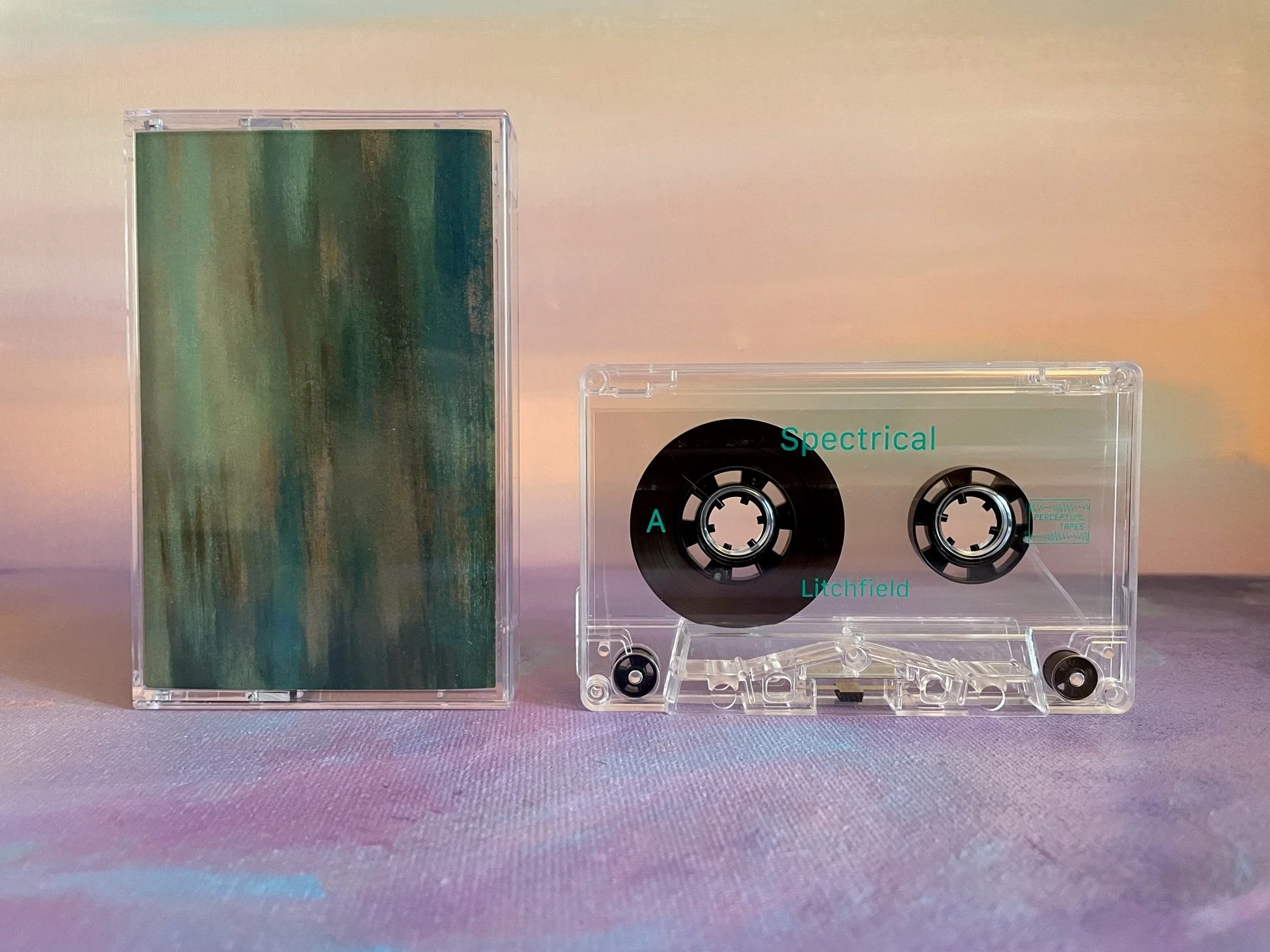
Litchfield is an immersive album shaped by the lush, expansive wilderness of Australia’s Northern Territory. Inspired by time spent walking, swimming, and listening within Litchfield National Park and its surrounds, Spectrical weaves field recordings of birds, insects, bats, flowing water, and trees in the wind into slowly unfolding compositions. These environmental fragments were first transferred to cassette tape, becoming the textural foundation of the record. Recorded with analogue synthesizer, electric guitar, kalimba, glockenspiel, modular electronics, and tape-based processes, Litchfield drifts between documentation and abstraction; suspended between field and studio, where environment and composition converge.
Tracklist
Album Credits
Press
Perceptual Tapes continues to establish itself as one of the more quietly essential labels operating within contemporary ambient and experimental music. The label’s catalog consistently favors atmosphere over spectacle, intimacy over excess, and deep listening over immediacy. Two recent releases, Fading Bright by memorysound and Litchfield by Spectrical, embody these values beautifully. Though distinct in approach and geography, both albums explore memory, environment, and emotional resonance through sound that feels profoundly tactile and human. Together they form a kind of dialogue between inner and outer landscapes, between recollection and observation, between fading light and living wilderness.
…
If Fading Bright explores internal memory and emotional residue, Litchfield by Spectrical turns outward toward the natural world while arriving at similarly profound emotional terrain. Inspired by time spent within Australia’s Litchfield National Park, Timothy Allen’s latest work exists somewhere between field recording documentation and immersive ambient composition. It is an album deeply connected to place, yet it transcends simple environmental portraiture.
Allen’s process is particularly fascinating. Field recordings of birds, insects, bats, flowing water, and wind moving through trees were first transferred to cassette tape before becoming the foundational material for the album. This additional layer of mediation transforms the recordings into something more dreamlike and unstable. Nature itself becomes filtered through memory, texture, and time.
The opening passages of Litchfield immediately establish a sense of spatial vastness. Sounds do not simply appear within the stereo field. They seem to emerge from immense distance, moving through layers of atmosphere before reaching the listener. Water trickles softly beneath drifting synthesizer tones while insects pulse rhythmically at the edges of perception. The effect is immersive without becoming overly literal.
Allen’s background in sound design is evident throughout the album. Since beginning the Spectrical project in 2012, he has consistently explored unconventional recording techniques and textured sonic environments. On Litchfield, these interests reach a remarkable level of refinement. Acoustic instruments, modular electronics, electric guitar, kalimba, and glockenspiel blend seamlessly with environmental recordings, dissolving distinctions between organic and synthetic sound sources.
What makes Litchfield particularly compelling is its refusal to romanticize nature. This is not pastoral ambient music designed merely for relaxation. The wilderness presented here feels alive, mysterious, and at times unknowable. Insects swarm in dense rhythmic clusters. Wind howls through spaces with eerie resonance. Distant animal sounds appear momentarily before vanishing back into darkness. Allen captures not only the beauty of the environment but its strangeness and enormity.
There is also an extraordinary sense of motion throughout the album. Tracks drift slowly like long hikes through unfamiliar terrain, guided less by traditional structure than by subtle environmental transitions. The listener moves through spaces rather than songs. Sounds overlap and dissolve into one another with dreamlike fluidity.
The tape-based processes play a crucial role in shaping the album’s emotional character. Cassette degradation softens sharp edges and introduces gentle instability, making even the clearest field recordings feel slightly haunted by time. This approach aligns beautifully with the album’s larger themes of perception and memory. What we hear is not nature presented objectively but nature remembered, filtered through personal experience and sonic transformation.
Allen’s use of silence and negative space is equally masterful. Some passages become nearly still, allowing tiny sonic details to emerge with startling clarity. A single insect rhythm or faint harmonic drone can suddenly feel monumental within these sparse environments. This careful attention to dynamics and pacing demonstrates remarkable compositional maturity.
Taken together, Fading Bright and Litchfield reveal the emotional and conceptual breadth possible within contemporary ambient music when approached with sincerity and imagination. Both artists resist easy categorization or formulaic structures, choosing instead to create deeply immersive worlds shaped by texture, emotion, and atmosphere.
Perceptual Tapes deserves significant recognition for curating releases of such depth and nuance. In an era increasingly dominated by algorithmic consumption and disposable listening habits, albums like these remind us of the value of slowness and attentiveness. They ask listeners not merely to hear but to inhabit sound.
Fading Bright glows with intimate nostalgia, offering fragile emotional fragments suspended in analog haze. Litchfield expands outward into living ecosystems transformed through tape and memory. One turns inward while the other reaches toward the external world, yet both ultimately arrive at similar truths about impermanence, presence, and the elusive nature of experience itself.
These are albums that reward solitude and repeated listening. Their beauty unfolds gradually, revealing deeper emotional and sonic layers over time. In their quiet way, both memorysound and Spectrical have created works of intimate poetic resonance, albums capable of transforming space, perception, and mood long after the final sounds fade into silence.
Don Haugen
//
Litchfield, the latest album from Spectrical, borrows its name from the expansive Litchfield National Park in Northern Australia as well as its sounds. The album is comprised of a wide array of field recordings taken directly from time spent there and accompanied by a wide variety of synthetic and acoustic sounds to include analog synths and kalimbas. The result is an album that is equal parts natural and otherworldly sounding as the two differing approaches to textural creation, both synthetic and non-synthetic, meld into a dreamy and immersive series of soundscapes.
With the synthetic textures present here, there’s a combination of approaches that create vastly different pieces. “Morning Light” opens with birds chirping and a slowly rising and falling synth that feels more or less seamless. But “Trees at Our Feet to the Horizon” features a synthetic texture that embraces those seams. The pads here give a sense of constant motion as they have a slight jarring sensation as each new chord comes in, actively cutting off the previous. It gives the entire track a pleasantly disjointed feeling, which is helped by the much more sparse field recordings than heard previously in the album. The vibe given off here is one of watching the sun slowly set as we hear less and less from nature as the daytime wildlife goes to sleep and the nocturnal wildlife wakes up slowly.
By the end of the album, we are taken into full nighttime on “Ancient Starlight.” The field recordings here are far more subtle as we hear the faint song of crickets or cicadas and small tinges of the nighttime ambiance. Just that subtle quiet sound that signifies a slower and more mysterious time in the natural cycle. This subtle quietude is supported by the return of seamless and endlessly drifting ethereal pads, floating seemingly effortlessly in the midst of a twinkling black sky. It’s a rather fitting end for such a sublime and gentle album.
Lars Haur